
GaN chargers versus silicon chargers for mobile devices
Advertisement
GaN chargers supply higher electrical wattage in smaller enclosures and produce less waste heat than traditional silicon-based power bricks. This upgrade benefits smartphone, tablet, and laptop users who carry several devices or need faster power delivery on the go, though GaN units cost noticeably more at retail and do not increase the maximum charging rate that your phone is designed to accept.
Every mobile device relies on an internal power management circuit that dictates the highest current and voltage it can handle safely. Replacing a factory charger with a third-party accessory requires an understanding of what internal semiconductor materials do, how power distribution protocols operate, and whether paying a premium for modern semiconductor architecture delivers any tangible practical advantage for your personal collection of portable electronics.
Understanding the shift from silicon to gallium nitride
For decades, silicon has served as the baseline semiconductor material for consumer power supplies, computer processors, and wall adapters. Silicon semiconductors manage the flow of electrical power from an alternating current wall outlet into direct current suitable for mobile batteries. However, silicon possesses physical limits regarding how quickly it can switch electric current and how much heat it generates when forced into compact plastic housings. As consumer electronics demanded faster charging protocols exceeding 30, 65, and 100 watts, silicon adapters grew substantially larger and heavier to prevent internal components from overheating.
Advertisement
Gallium nitride, commonly abbreviated as GaN, is a wide bandgap semiconductor material that conducts electrical current far more efficiently than standard silicon. In physics, the bandgap refers to the energy required for electrons to jump from a valence band to a conduction band to transmit power. Gallium nitride features a bandgap roughly three times wider than silicon, allowing components to withstand higher operating voltages and switch electric currents at much higher frequencies without breaking down.
Because GaN components switch electrical currents at speeds substantially higher than legacy silicon alternatives, internal transformers, capacitors, and inductors can be made physically smaller while processing the same electrical load. This material shift represents an evolutionary leap in power conversion hardware, allowing power brick manufacturers to reduce the volume of their hardware without reducing power output. When evaluating GaN chargers versus silicon models, the fundamental divergence lies in basic electrical efficiency and component density rather than software protocols.
Physical size and portability differences
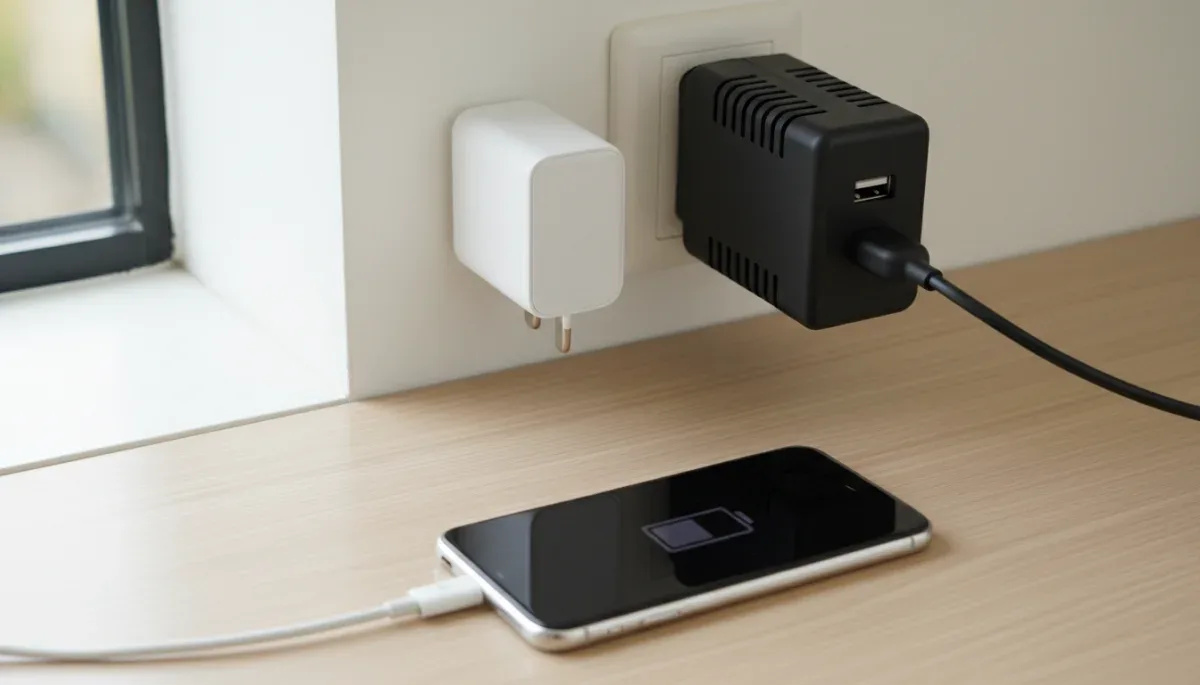
The most visible distinction between GaN chargers versus silicon chargers is physical footprint. A standard legacy silicon charger capable of delivering 65 watts of continuous power often measures four to six cubic inches and can weigh upwards of half a pound. In contrast, an equivalent GaN-based adapter delivering that same 65 watts routinely occupies under half of that physical volume. This reduction simplifies packing for business travel, commuting, or everyday carry in a pocket or purse.
Beyond simple volume, the form factor of power adapters impacts how they interact with domestic electrical infrastructure. Heavy silicon adapters frequently suffer from leverage issues when plugged into vertical wall outlets, causing them to loosen or pull out of older sockets due to gravity. Smaller GaN designs place their center of gravity closer to the wall plate, creating a more stable connection in residential outlets, airport charging kiosks, and crowded power strips.
When selecting a portable charger, consumers should examine the specific physical housing details before purchasing:
- Foldable wall prongs: Many compact GaN models incorporate retractable prongs that fold flat against the body, protecting delicate fabric pockets and luggage lining from accidental tears during transport.
- Port spacing and orientation: Ultra-compact chargers sometimes place multiple USB ports closely together, which can block neighboring plugs if you use cables with thick or molded strain-relief collars.
- Wall strip clearance: Slim vertical designs allow users to plug adapters side by side on power strips without covering adjacent receptacles, whereas wide horizontal bricks often obstruct two or three outlets at once.
Thermal management and operating efficiency
Every electrical charger converts high-voltage alternating current from a wall socket into low-voltage direct current through internal switching cycles. During this conversion, a portion of the electrical energy is inevitably lost as ambient heat. Legacy silicon components encounter higher electrical resistance during high-speed switching, which leads to higher thermal output. When a silicon charger runs hot, its internal efficiency drops further, requiring bulky aluminum heat sinks, thermal potting compounds, and thick insulating plastic shells to dissipate the thermal energy safely.
GaN chargers operate with significantly lower electrical resistance and higher thermal conductivity than silicon. As a result, less electrical energy is lost as radiant heat during the power transformation process. A high-efficiency GaN charger can convert over 90 percent of incoming wall energy directly into usable battery charge, keeping internal operational temperatures well within manufacturer safety thresholds even when working near peak wattage limits.
This thermal advantage preserves component longevity. Excessive heat over time accelerates the degradation of internal electrolytic capacitors, solder joints, and plastic casings in power supplies. By maintaining cooler internal temperatures during extended charging sessions, GaN adapters lower thermal stress on passive components. However, readers should recognize that a compact GaN adapter will still feel warm or moderately hot to the touch on its outer casing because manufacturers use the outer shell as a heatsink to vent thermal energy outward quickly.
Charging speeds and multi-device power delivery
A frequent misconception among mobile shoppers is that plugging a phone into a GaN charger automatically forces the battery to fill up faster. In reality, charging speed is governed entirely by the communication between the phone and the charger via industry protocols like USB Power Delivery (USB-PD) or proprietary standards like Qualcomm Quick Charge. If a smartphone hardware controller is engineered to accept a maximum of 25 watts, plugging it into a 100-watt GaN charger will still result in a 25-watt charging rate.
Where GaN excels is multi-device power negotiation. Because GaN components handle large total wattages within small enclosures, manufacturers routinely equip GaN adapters with two, three, or four separate output ports. These adapters incorporate intelligent dynamic power allocation chips that automatically calculate and split the total wattage pool depending on how many cords are actively connected to devices.
Understanding how dynamic power split configurations operate helps avoid unexpected charging slowdowns:
- Single-device priority: Connecting a single laptop to a 65-watt multi-port GaN charger generally supplies the full 65 watts through the primary port for maximum charging velocity.
- Automated re-negotiation: Plugging a second device into an adjacent port forces the internal controller to momentary pause power, recalculate demands, and redistribute current, such as 45 watts to the laptop and 20 watts to the phone.
- Fixed low-power ports: Secondary USB-A ports on multi-port bricks often remain capped at 5 to 12 watts, which is sufficient for wireless earbuds or smartwatches but inadequate for rapid phone replenishment.
- Cable capacity checks: Achieving maximum speed requires an electronically marked (e-marker) charging cable rated for 5 amps and 100 watts; otherwise, the charger throttles output to 60 watts regardless of the brick capacity.
Durability, longevity, and device safety features
Modern mobile phones, tablets, and laptops contain sophisticated internal battery management systems that monitor incoming voltage, electric current, and internal battery temperature thousands of times per minute. Connecting a mobile device to an aftermarket GaN or silicon charger carries no inherent danger as long as the charger adheres to certified international safety guidelines. Both silicon and GaN bricks sold by reputable suppliers feature standard protection against short circuits, overvoltage, overcurrent, and extreme internal overheating.
Durability differences between the two materials arise primarily from internal structural construction. Because silicon chargers require substantial physical space for heat dissipation, internal boards are spread out, and components may be exposed to vibration if dropped repeatedly on hard surfaces. GaN chargers feature dense, tightly integrated micro-architectures that are frequently secured with solid structural potting compounds, offering high structural resilience against daily drops, bag jostling, and physical compression during travel.
To ensure device safety when purchasing non-OEM chargers, shoppers should inspect hardware labels for certification marks issued by nationally recognized testing laboratories. Look for independent compliance stamps such as UL (Underwriters Laboratories), ETL (Intertek), or CE marks indicating adherence to regional consumer electrical standards. Uncertified budget chargers, regardless of whether they advertise GaN or silicon internals, often cut costs by omitting basic fuses, surge suppression metal-oxide varistors, or thermal auto-shutoff sensors, posing potential fire or hardware hazards.
Price comparisons and retail purchasing considerations
Manufacturing mature silicon chips is an established, high-volume industrial process with minimal production scrap, making standard silicon wall plugs very inexpensive to manufacture. Silicon chargers bundled in retail packaging or sold as basic replacements generally retail between 10 and 20 dollars at major online and brick-and-mortar storefronts in the United States. They provide reliable, basic utility for overnight bedside charging where physical size and multi-device capabilities do not matter.
GaN wafers require more specialized chemical vapor deposition processes and cleaner manufacturing conditions, which translates directly to higher component acquisition costs for peripheral brands. High-grade GaN chargers typically range between 25 and 70 dollars, scaling upward based on total wattage, brand reputation, and the number of active USB-C ports. For budget-conscious consumers who only charge a single phone on a nightstand while sleeping, paying three times the price for a GaN adapter offers little everyday functional return.
However, the economic calculation changes for consumers who travel frequently or carry multiple hardware items. A single 100-watt multi-port GaN charger can successfully replace a proprietary laptop power brick, a tablet plug, and a smartphone wall wart simultaneously. In this scenario, purchasing one premium multi-port GaN charger proves more economical, lighter, and less cluttered than buying three distinct standard silicon replacements from original hardware manufacturers.
At a glance
| Feature | What to know |
|---|---|
| Physical volume | GaN chargers are approximately 30 to 50 percent smaller than silicon chargers of identical wattage. |
| Operating heat | GaN materials produce less internal waste heat, allowing higher power transfer in tighter housings. |
| Charging speed | Charging speed depends on your mobile device protocol limits, not on the charger semiconductor material. |
| Retail pricing | Standard silicon power bricks remain significantly cheaper to purchase than comparable GaN units. |
Frequently asked questions
Will a GaN charger damage my mobile phone battery?
No, a certified GaN charger will not harm your phone battery. Your mobile phone draws only the specific electrical wattage it is programmed to accept. As long as the charger complies with official USB Power Delivery standards, high-wattage GaN chargers automatically step down power safely.
Can a GaN charger charge my laptop and phone at the same time?
Yes, multi-port GaN chargers are engineered specifically to power laptops and phones concurrently. The internal controller divides its total available wattage across active ports, directing higher wattage to the laptop port while sending a lower baseline current to the smartphone port.
Why does my compact GaN charger feel hot while in use?
GaN chargers feel warm because their compact outer shells function directly as passive heat sinks. Because there is little empty internal space, thermal energy transfers quickly to the plastic exterior to dissipate into surrounding room air rather than accumulating inside near sensitive electrical components.
Do I need a special cable to use a GaN charger?
You need a compatible USB-C cable that supports your target charging speed. While any standard cable delivers basic power, accessing high speeds above 60 watts requires a certified 100-watt or 240-watt cable containing an integrated electronic marker chip to communicate safely with the power adapter.
The bottom line
Choosing between GaN chargers versus silicon chargers comes down to your personal travel habits and how many electronic devices you carry daily. If you need a compact, all-in-one power adapter capable of charging a modern laptop, tablet, and smartphone from a single outlet, investing in a reputable GaN charger offers tangible space and weight savings. Before making a final purchase, check the maximum wattage and charging protocol supported by your phone on the manufacturer official website to ensure you do not overpay for power your hardware cannot utilize.
Written by
Mariana Viana
Mariana Viana writes about clothes for flowershein.com. Each article explains how things work, compares published details such as prices, policies and program rules, and points readers to the official source before they decide.