
How tension rod cabinet organizers work for storage
Advertisement
A tension rod cabinet organizer works by using an internal mechanical spring or threaded expansion core to push opposing rubber end caps against parallel cabinet walls, creating a friction-based suspension point without screws or hardware. This mechanism allows you to transform unused vertical and horizontal space into custom racks for spray bottles, dividers for baking sheets, or tiered shelving in tight storage areas.
This hardware-free setup helps apartment renters, homeowners with older cabinetry, and anyone with compact layouts maximize neglected corners without drilling permanent holes. The primary limitation is that tension rods rely entirely on surface friction and compressive force, meaning improper installation, oily or slick cabinet walls, or excessive weight will cause the rod to slip out of place.
How internal springs create stable cabinet storage
The standard tension rod contains two telescoping metal or plastic tubes, an internal coiled steel spring, and an integrated threaded mechanism. When you twist the inner tube relative to the outer tube, an internal nut travels along a coarse-pitch screw thread, extending or retracting the overall length of the rod. Fine adjustment occurs when the rod is set slightly wider than the internal opening of the cabinet, forcing you to compress the internal spring manually as you slide the rod into position between the two structural cabinet sides.
Advertisement
Once released, the compressed internal spring continuously pushes outward against both walls. This sustained lateral pressure generates normal force against the interior panels. According to basic physical friction principles, the holding capacity of the rod equals this normal force multiplied by the static friction coefficient of the end caps against the cabinet surface. Soft, textured rubber end caps provide a much higher coefficient of friction against painted wood, melamine, or laminate than smooth plastic caps, reducing the likelihood of sudden dropouts under load.
Understanding these mechanical principles prevents common installation errors. If an installer fails to extend the rod beyond the wall-to-wall dimension before compressing it into place, the internal spring remains uncompressed, generating zero normal force and leading to immediate failure under minor downward pressure.
Core mechanical components of tension organizers
- Telescoping outer barrels: Powder-coated steel or extruded aluminum tubes that provide structural rigidity against bending or bowing.
- High-tensile internal springs: Steel coils that maintain constant outward lateral pressure across minor temperature and humidity fluctuations.
- Molded rubber foot pads: High-grip elastomer caps designed to grip cabinet finishes without stripping paint or denting particle board.
- Rotational locking collars: Internal threaded wedges that prevent the telescoping tubes from collapsing inward under lateral pressure.
Organizing vertical space under kitchen sinks
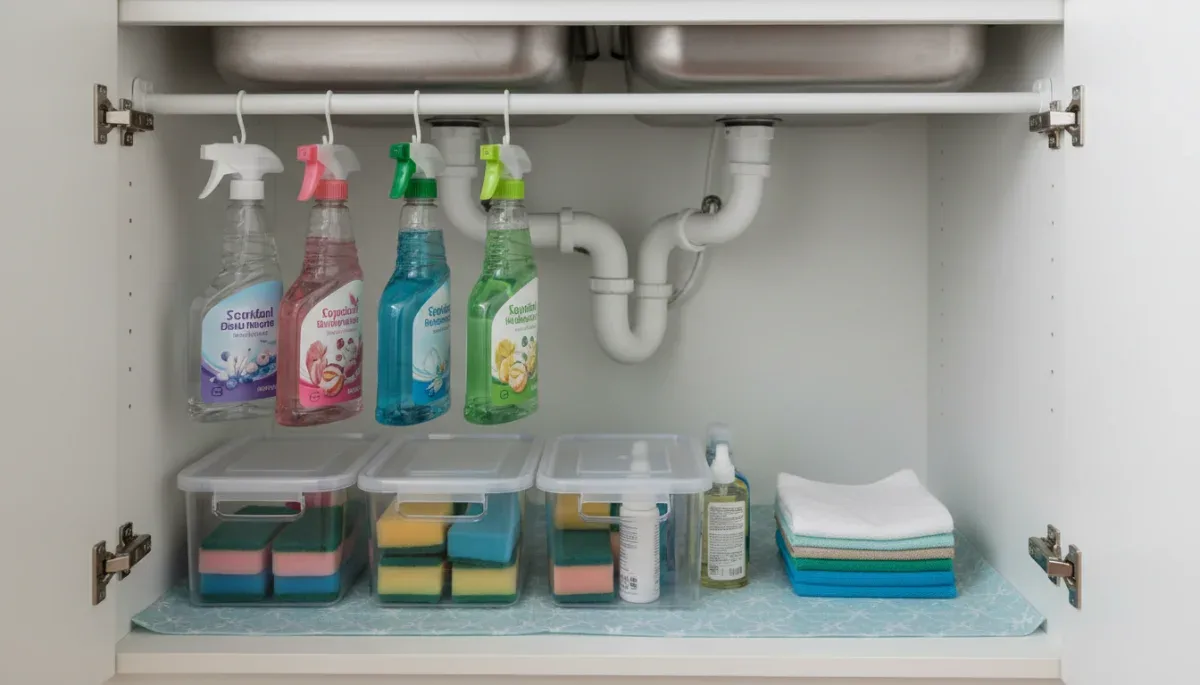
Under-sink kitchen areas present unique organizational challenges due to large drainage traps, flexible supply lines, and electrical disposal units that divide the central space. A tension rod cabinet organizer bypasses these irregular mechanical obstacles by suspending items in the upper perimeter of the cabinet where fixed shelves cannot fit. Positioning a horizontal tension rod between three and five inches below the cabinet roof creates an elevated hanging rail specifically suited for cleaning products.
Standard household trigger-spray bottles, such as surface cleaners, degreasers, and glass sprays, hang naturally by their pump necks along the horizontal barrel of the rod. By elevating these containers off the cabinet floor, you double the usable floor area below for stackable bins, dishwasher detergent buckets, or scrub brushes. This elevated orientation also prevents moisture from pooling around bottle bases, reducing the development of mildew on the bottom cabinet board.
For deeper kitchen cabinets, multiple parallel tension rods can create light-duty upper shelves. Placing two or three rods at identical heights approximately two inches apart allows you to rest flat wire baskets or plastic caddies across the bars, providing a level platform for sponges, scrubbing pads, and spare trash bags without impeding access to the plumbing below.
Dividing baking sheets and cutting boards vertically
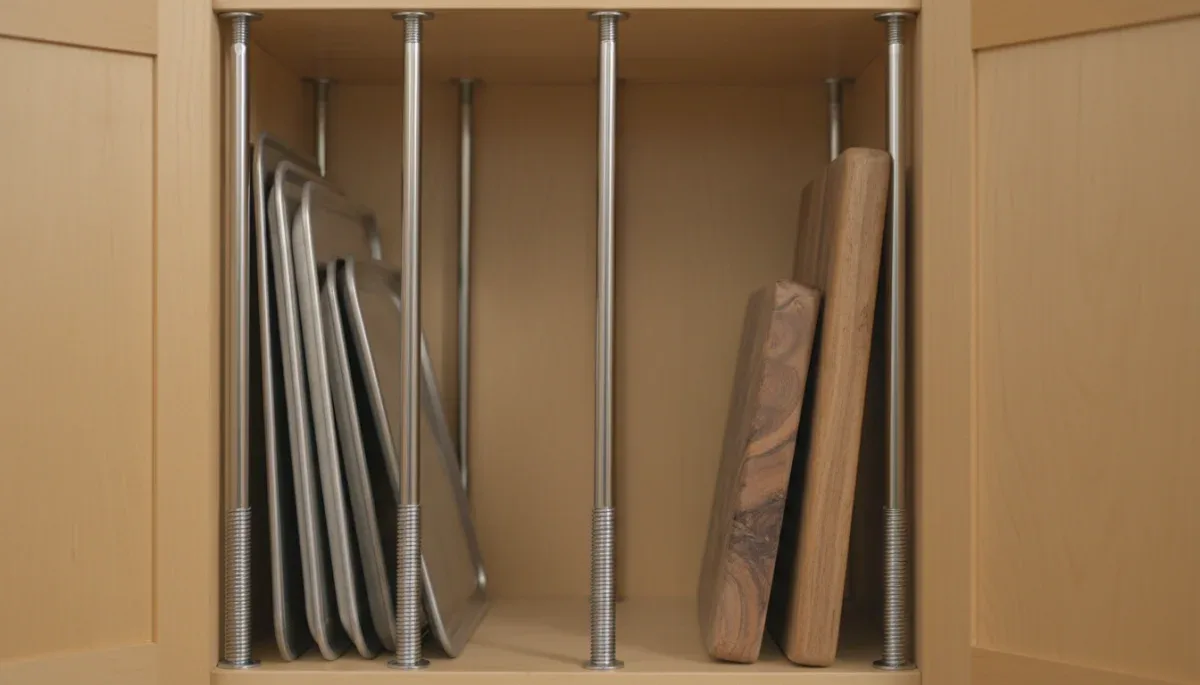
Deep lower kitchen cabinets often become disorganized when flat items like muffin tins, cookie sheets, serving platters, and cutting boards are stacked horizontally on top of each other. Retrieving an item from the bottom of a heavy stack requires lifting every tray above it, which often scratches cookware coatings and chips cabinet shelving. Installing tension rods vertically converts standard horizontal shelf space into dedicated, upright storage slots.
To establish vertical dividers, position individual rods vertically between the fixed bottom shelf and the upper cabinet frame or upper shelf. Placing pairs of vertical tension rods four to six inches apart from front to back creates individual channels. Trays and cutting boards slide into these upright channels on their edges, remaining clearly visible and individually accessible without disturbing neighboring items.
When implementing vertical tension divisions, verify that the upper shelf above the rods is securely anchored. Vertical rods exert upward pressure on the upper surface; if the upper shelf rests on loose, unpinned plastic support pegs, the tension force can push the shelf upward off its pins, causing the shelf and rods to destabilize simultaneously.
Installation steps for vertical cabinet dividers
- Clean contact points: Wipe down the upper and lower cabinet surfaces with isopropyl alcohol to remove accumulated grease and cooking residues.
- Set initial length: Twist the rod so that its total uncompressed length measures approximately one-half inch longer than the vertical opening.
- Compress and position: Place the bottom rubber cap on the shelf base, compress the internal spring downward, and bring the top cap into vertical alignment.
- Verify vertical plumb: Use a small torpedo level or visual reference to ensure the rod is perpendicular, which prevents lateral displacement when boards rest against it.
Maximizing narrow bathroom vanities and medicine cabinets
Bathroom vanities face spatial constraints from sink basins and water shut-off valves, while medicine cabinets suffer from shallow interior depths that rarely exceed four inches. A compact tension rod cabinet organizer provides tailored storage solutions in both environments by taking advantage of small, modular dimensions. Because mini tension rods are sold in spans as narrow as seven to twelve inches, they fit inside narrow medicine chests or between a sink basin wall and an outer vanity panel.
In medicine cabinets, positioning a miniature tension rod half an inch above a glass or plastic shelf creates an effective retaining bar. This bar holds prescription containers, small cosmetic tubes, and dropper bottles securely in place, preventing them from falling out onto the bathroom floor whenever the cabinet mirror door is opened quickly. In deep under-sink bathroom vanities, horizontal tension rods allow you to hang handled baskets or hook S-shaped clips for hair styling appliances, washcloths, or bagged bath salts.
Moisture control is an essential consideration in small bathrooms. Warm steam from showers raises ambient humidity, which can soften rubber caps or promote condensation along metal tubes. Choosing tension rods constructed from coated aluminum, stainless steel, or moisture-resistant polymer prevents rust formation and helps the rubber feet maintain a firm grip on smooth acrylic or laminate vanity interiors.
Weight limits and load distribution guidelines
Tension rods are designed for lightweight utility rather than heavy structural support. The published weight capacity of standard commercial spring rods between twelve and twenty-eight inches typically ranges from three to ten pounds, depending on rod diameter and build quality. Exceeding these limits causes the metal barrel to flex downward at the center point. This bowing action angles the end caps inward, significantly reducing the surface contact area of the rubber pads and leading to sudden failure.
Distributing weight evenly along the rod is essential for maintaining stability. Concentrating multiple full spray bottles or liquid jugs directly in the center of the span maximizes rotational torque on the end caps. Instead, position heavier items closer to the outer ends near the cabinet side walls, where structural rigidity is highest, while keeping lighter items toward the center.
The total span also directly affects structural capacity. A tension rod extended to its maximum rated length has less overlap between its inner and outer telescoping tubes, making it significantly more prone to bowing than a longer rod model operated near its minimum collapsed length. For an opening measuring twenty inches, selecting an eighteen-to-thirty-inch rod provides greater structural stability than using a twelve-to-twenty-inch rod extended to its absolute threshold.
Preventing slip and protecting cabinet walls
The most frequent failure mode for any tension rod cabinet organizer is slippage along the cabinet sidewall. Over time, vibrations from closing cabinet doors, fluctuations in indoor temperature, and gradual relaxation of the internal spring can weaken the initial grip. Furthermore, raw particle board or unsealed wood surfaces can shed fine dust particles, forming a loose boundary layer that degrades rubber friction.
To establish long-term reliability on difficult surfaces, you can reinforce the contact points without making permanent alterations to the cabinetry. Placing small squares of clear silicone grip tape or adhesive non-slip mounting pads beneath each rubber cap prevents lateral sliding while protecting soft finishes from pressure indents. These removable pads increase the static friction coefficient significantly without requiring screws.
If you are organizing heavy items inside rental cabinetry where screws are prohibited, shallow adhesive-backed plastic mounting sockets offer a secure alternative. These cups stick to the cabinet walls using removable acrylic adhesive, providing a physical lip that catches the rod end caps and prevents vertical downward movement even if the internal spring loses tension over time.
At a glance
| Factor | What to know |
|---|---|
| Mechanism | Uses internal coiled springs or threaded expansions to create lateral friction against walls. |
| Weight capacity | Typically holds three to ten pounds, requiring distributed loading away from the center. |
| Wall compatibility | Grips best on clean painted wood, laminate, or melamine; struggles on dusty raw particle board. |
| Installation damage | Leaves zero screw holes, though excessive tension can cause minor indents in soft substrates. |
Frequently asked questions
Can tension rods damage interior cabinet surfaces?
Tension rods do not drill holes or strip veneers, but over-tightening an aggressive spring rod against thin, unreinforced particle board can leave circular pressure indents. Ensure the rubber end caps remain clean and supple, and avoid applying excessive force against lightweight hollow cabinet walls.
How do I prevent tension rods from falling down unexpectedly?
Clean the cabinet sidewalls thoroughly with alcohol to eliminate grease films before installation. Always extend the rod approximately one-half inch wider than the target opening, compress the spring firmly into place, and keep hanging items distributed toward the outer edges rather than the middle.
Are tension rods suitable for holding heavy pots and pans?
No, standard tension rods cannot reliably support cast iron skillets, ceramic cookware, or heavy stockpots. They are engineered strictly for lightweight utility, such as spray bottles, small towels, spice containers, and vertical sheet pan dividers that rest their primary weight on the shelf floor.
What size tension rod should I buy for standard cabinets?
Measure the interior width of your cabinet frame with a tape measure before purchasing. Select a rod model where your measured dimension falls in the lower or middle half of the product's adjustable range, ensuring sufficient tube overlap inside the barrel to prevent center bowing under load.
The bottom line
A tension rod cabinet organizer provides an inexpensive, drill-free method to recover vertical space, separate flat cookware, and streamline under-sink clutter in compact rooms. Success depends entirely on selecting the correct length range, balancing modest loads across the bar, and maintaining high surface friction between rubber caps and cabinet walls. Before buying, measure your cabinet's exact internal width and check whether the sidewalls are rigid enough to sustain continuous outward spring pressure.
Written by
Rita Lima
Rita Lima writes about clothes for flowershein.com. Each article explains how things work, compares published details such as prices, policies and program rules, and points readers to the official source before they decide.